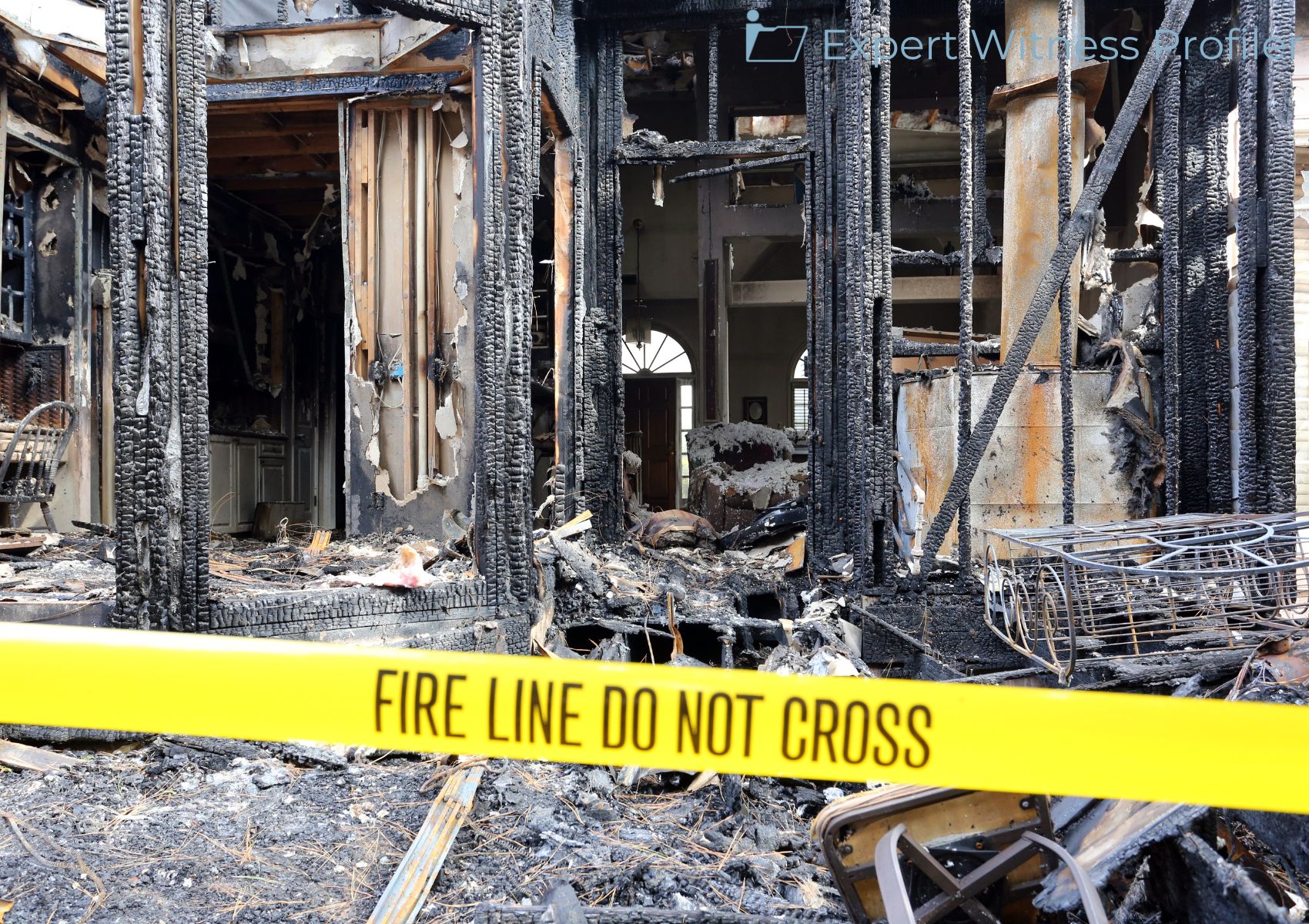
Defendants owned and managed an apartment complex called The Trails at Flat Rock in Columbus, Georgia. In October of 2022, a fire occurred in Building A of the apartment complex. Kevin Ford, who was staying in unit A-24 with tenant Anthony Thorpe, died in the fire. Plaintiff, the administrator of Ford’s estate, asserted negligence claims against Defendants based on Ford’s death, alleging that Defendants’ negligence caused Ford’s death and pre-death pain and suffering.
Plaintiff intended to support these claims with the expert testimony of Kevin Foster and Lisa Detter-Hoskin. Defendants argued that the testimony of these two experts should be excluded.
Burns Expert Witness
Dr. Kevin Foster is the Director of Burn Services at the Diane & Bruce Halle Arizona Burn Center Valleywise Health. Foster is a medical doctor who has specialized in burn care since 1999.
Lisa Detter-Hoskin has a Ph.D. in inorganic chemistry with minor focus in analytical chemistry from Purdue University. She has successfully completed the National Association of Corrosion Engineers Basic Corrosion Science class. Detter-Hoskin was a lead expert who worked 10 years on the United States’ largest chlorine spill which occurred when Norfolk Southern Railway derailed a train and released chlorine onto Avondale Mills and residences in Graniteville, SC on January 6, 2005.
Foster opined that Ford’s death was caused by a combination of smoke inhalation and burn injury, as opposed to solely smoke inhalation injury. Foster also concluded that Ford suffered conscious pain and suffering from his burns before his death.
Defendants contended that Foster’s testimony should be excluded as unreliable because Foster’s opinions are speculative and not based on reliable principles that would assist the trier of fact.
I. Defendants’ Motion to Exclude Kevin Foster
To prepare his report, Foster relied on the Georgia Bureau of Investigation’s (“GBI”) autopsy report and photographs, the Muscogee County Coroner’s Report, Columbus Fire Department and Columbus Police Department reports and photographs, Thorpe’s deposition, and other photographs from the fire scene. Defendants did not appear to challenge Foster’s basic methodology, which was to consider all the medical records, photographs, and reports available to him and determine Ford’s cause of death based on that information and his training, experience, and skill as a burn care physician.
Rather, Defendants challenged Foster’s conclusions—including his conclusion that Ford was conscious at the time of the fire and experienced pain and suffering due to burns before he died. According to Defendants, Foster misinterpreted the evidence and reached the wrong conclusions about whether Ford was asleep at the time of the fire. Foster, though, explained why he interpreted the evidence as he did and how he reached his conclusions that Ford was conscious and trying to escape the fire when he suffered burns. The Court found that Defendants’ criticisms of Foster’s testimony went to its weight, not its admissibility. Thus, based on the present record, the Court did not find that Foster’s methodology was unreliable.
Defendants also criticized Foster’s analysis as a “cut and paste job” because Foster mistakenly referred to a “Mr. Noble” in two places in his report. The Court declined to exclude Foster’s testimony because of the mistakes in his report.
II. Defendants’ Motion to Exclude Lisa Detter-Hoskin
Defendants also sought to exclude the testimony of Plaintiff’s rebuttal expert, Lisa Detter-Hoskin. Plaintiff hired Detter-Hoskin to rebut certain opinions offered by the Defendants’ fire investigation expert.
Defendants argued that Detter-Hoskin’s opinions are outside the scope of permitted rebuttal testimony under the Federal Rules of Civil Procedure.
Defendants argued that Detter-Hoskin’s testimony did not rebut expert opinions as to the cause of the damage to the backplate of the cooking range because the expert in question did not “opine as to what caused the damage to the back plate of the range.”
After examining and analyzing materials from the kitchen of unit A-23, Detter-Hoskin opined that “the damage to the cooking range back plate and aluminum backsplash was not the result of the direct flame impingement, radiant heat, or conductive heat from the fall down debris located to the left of the stove.” Thus, Detter-Hoskin’s conclusions directly contradicted expert opinions as to the cause of the damage to the stove backsplash and back part of the range. Accordingly, the Court found that Detter-Hoskin is a proper rebuttal expert under Rule (26)(a)(2)(D)(ii).
Held
The Court denied the Defendants’ motions to exclude the testimony of Kevin Foster and Lisa Detter-Hoskin.
Key Takeaway:
A rebuttal report may not advance a completely new legal theory, but courts must examine the primary expert reports to determine whether the rebuttal report is truly “new” or merely uses different terminology to address issues that were raised in the primary expert reports.
Please refer to the blog previously published about this case:
Plaintiff The Upper Deck Company (“Upper Deck”) sued its former contractor, Ryan Miller (“Miller”), and its competitor, Ravensburger North America Inc. (“Ravensburger”), for claims arising from the alleged copying of Upper Deck’s new trading card game (“TCG”), Rush of Ikorr.
Miller filed motions to exclude Plaintiff’s expert witnesses Dr. Roberto J. Cavazos and Dr. Ian Bogost while Plaintiff filed a motion to exclude Miller’s expert witness James E. Pampinella.
Gaming Expert Witness
Dr. Ian Bogost serves as a professor of Film and Media Studies as well as Computer Science and Engineering at Washington University in St. Louis and enjoys international recognition “as a key figure in game design and game studies.”
Dr. Roberto J. Cavazos is an economics professor with thirty years of experience. He has worked in a number of areas including lost earnings, business damages, labor management relations for global multinationals.
James E. Pampinella CPA, CFF, CLP has been providing consultation services in the area of complex commercial litigation and valuation services for over 30 years, specializing in intellectual property strategic consulting and disputes, including matters involving copyrighted works.
Miller’s Motion to Exclude Plaintiff’s Expert Bogost
Bogost is qualified to testify about TCGs
Miller sought to exclude Bogost’s testimony, arguing that he is not qualified to opine on TCGs, that his methods are unreliable, and that he offered improper legal opinions.
The Court noted that Bogost’s CV has a marked video game slant. However, his CV also contains several indications of general game expertise: throughout his career, Bogost has written several publications on games and game theory generally, taught multiple university courses on game design, and presented at several conferences on games.
Given Bogost’s ample experience in the field of games, game design, and game review—and because his opinions are based on specialized knowledge other than science—the Court found that Bogost met the minimum bar set by Rule 702 to qualify as an expert on TCGs.
Bogost’s methodology is sufficiently reliable to offer expert opinions about the two TCGs
Miller also challenged the reliability of Bogost’s methodology. Bogost first obtained two sets of Lorcana starter decks, which included “ready to play” decks, a booster pack of cards, a tabletop play mat, printed rules, and “a set of cardboard chits.” Bogost next considered what version of Rush of Ikorr to use in his analysis. After reviewing case materials, Bogost obtained the materials Miller submitted to Upper Deck prior to his departure (“Version 2.6”), then played both games. After playing the games, Bogost made observations about each game, and formed opinions as to particular “bundles of expression” drawing on his experience in game design.
Miller took issue with how Bogost played Version 2.6 because he did not use overlays, and did not play in team mode. But as Upper Deck pointed out, Bogost could not recall whether he used the overlays and Rush of Ikorr can be played as a single-player or team-based game.
Bogost initially made determinations as to which versions of the games to obtain based on the particular facts in the record, then proceeded to play the games, and draw conclusions based on his knowledge of game mechanics.
Miller also moved to exclude Section E of Bogost’s report. In Section E, Bogost first explained that “rough-looking” materials, such as Version 2.6, still represent a substantially complete work product in the game design process. While the completeness of Version 2.6 was relevant to the copyright claim, the state of that work product when Miller left Upper Deck and whether it was sufficiently complete or valuable may also be relevant to Plaintiff’s contract claim.
Accordingly, the Court denied Miller’s motion to exclude Bogost.
B. Defendant’s Motion to Exclude Upper Deck’s Copyright Damages Expert Dr. Roberto Cavazos
In this case, Cavazos provided his opinion on copyright damages, estimating economic harm by analyzing the “market value” of rights allegedly taken, and by calculating Defendant Ravensburger’s profits allegedly derived from infringement of Upper Deck’s TCG.
Cavazos testified that his methods arise under copyright law, and were based upon his understanding from counsel of the applicable measure of copyright damages.
Cavazos does not attempt to quantify any alleged breach of contract by Miller, nor assign value to Miller’s work on Version 2.6 in the context of the profits from the Lorcana game, nor does it seem he would be qualified to do so. Rather, the royalty rate that Cavazos calculated considered only Ravensburger’s total global revenues and profits from sales of Lorcana, and did not attempt to apportion any value to Miller’s alleged disclosures of confidential information.
Cavazos admitted that he was not an expert in game design, did not identify the intellectual property at issue, and did not provide a basis for his one-third opinion, beyond that it “stands to reason” that some people would buy the game because of the underlying game design, not just because of the use of Disney IP.
The Court held that Cavazos’s opinions are no longer relevant to the issues in this case, and to the extent that they could be, he is not qualified to provide them.
C. Plaintiff’s Motion to Exclude Defense Damages Expert James Pampinella
With regard to Upper Deck’s general objection to Pampinella’s use of the costs approach, Upper Deck acknowledged that the method is one of three that is accepted by economic literature. Thus, Upper Deck’s objection to Pampinella’s decision to rely solely upon the costs approach concerned the weight rather than admissibility.
Upper Deck also took issue with Pampinella’s results under the costs approach, arguing that “it is illogical and unreliable for Pampinella to assert that there are no actual damages.” While Pampinella found no actual damages as to the alleged conduct of Ravensburger and Miller, he also concluded that Upper Deck could have suffered economic damages of up to $39,000—the amount paid to Miller under his contracts with Upper Deck.
The Court is also unpersuaded that Pampinella’s lack of expertise in the gaming industry damages renders his opinion inadmissible for the same reason it found Bogost’s lack of specialized TCGs experience not to be dispositive.
Held
The Court denied Miller’s motion to exclude Dr. Ian Bogost’s testimony.
The Court denied Upper Deck’s motion to exclude James E. Pampinella’s testimony.
The Court granted Miller’s motion to exclude Dr. Roberto Cavazos’ testimony.
Key Takeaway:
It is true that the Daubert standard can be more difficult to apply where “expert testimony is ‘experience-based’ rather than ‘science-based.’ But here, Bogost obtained the materials Miller submitted to Upper Deck prior to his departure (“Version 2.6”), then played both games. After playing the games, Bogost made observations about each game, and formed opinions as to particular “bundles of expression” drawing on his experience in game design.
Plaintiff The Lucia Family Trust (“Plaintiff” or the “Trust”) and non-party Daniel Unrein had a homeowners insurance policy (the “Policy”) with Defendant American Family Mutual Insurance Company, S.I. (“Defendant” or “American Family”). The policy covered a property located in Denver, Colorado (the “Property”). A fire occurred at the property in September 2021, and Unrein submitted a claim under the policy. Unrein passed away in November 2021, leaving the Trust as the remaining insured listed in the policy.
The repairs to the Property required asbestos abatement.The first contractor selected to perform the abatement, CAT Environmental Services, LLC (“CAT”), failed to complete the job and violated several Colorado Department of Public Health and Environment regulations, among other issues. The Trust then hired other contractors to complete the abatement and perform additional reconstruction work on the Property. Although American Family made some payments, the Trust alleged that American Family has refused to pay for approximately $112,000 of covered abatement and reconstruction work, in violation of the Policy.
American Family filed a motion to exclude certain opinions of Plaintiff’s insurance industry standards expert, Brian Seigal, pursuant to Rule 702.
Insurance Expert Witness
Brian Seigal has been involved in the insurance industry throughout his career for several decades. He served as the lead supervisor and claim manager position in property and casualty claims, the senior adjuster and team manager status of property and casualty claims at Liberty Mutual Group, in which capacity he adjusted, audited, and led multi-disciplinary claim teams.
Seigal is engaged as a consultant in a wide variety of insurance related cases, which include evaluation of first and third-party property claims.
In 1998 he earned and obtained the Associate Insurance Claims (AIC) Designation from the Insurance Institute, which is a nationally recognized insurance claims designation.
American Family first attacked Seigal’s qualifications as an expert under Rule 702(a). American Family argued that Seigal “has not worked in the insurance industry since 2018″—focusing instead on consulting work—and that his industry experience “did not involve property damage claims.”
To the extent American Family contended that Seigal must have specific experience in “homeowners property damage claims involving asbestos abatement,” that is an “overly narrow” test of Seigal’s qualifications. Rather, Seigal’s report reflected a familiarity with the applicable industry and statutory standards for handling property claims in Colorado.
Seigal has “passed the licensing exams for a Colorado Property & Casualty and Life Producer.” And his curriculum vitae and report describe over 20 years of experience at various stages of the claim-shandling process, including “reviewing and auditing thousands of open and closed claim files from 50+ claims departments for the adherence to company standards and practices.” Seigal’s more recent pivot to consulting work does not undermine his extensive industry experience.
The Court accordingly found that Seigal’s opinions regarding American Family’s handling of Plaintiff’s claim are “within the reasonable confines of his subject area” and will assist the jury in evaluating American Family’s conduct.
B. Methodology
American Family next attacked Seigal’s methodology. American Family faults Seigal for failing to analyze American Family’s conduct based on the information it had at the time it handled Plaintiff’s claim.
Seigal’s methodology essentially involved reviewing the facts of the case and relevant documents and then analyzing them based on his knowledge and experience of insurance industry standards. Courts routinely find that such a methodology is reliable for an insurance industry expert.
In light of Seigal’s methodology, the Court respectfully disagreed with American Family that Seigal failed to evaluate American Family’s conduct based on the information available at the time. Seigal’s report spends more than 50 pages detailing the timeline of the claim and specifically references the statements and communications made to and by American Family’s employees during the claim adjustment process.
American Family next argued that Seigal failed to set forth a methodology to support his statement that “liability was reasonably clear.”
In full, the relevant statement in Seigal’s report is:
“Liability was reasonably clear in this matter and the claim was accepted by [American Family]. Nonetheless, [American Family] put [Plaintiff] into a situation where they had to file multiple reports for the abatement process and proof of loss. [American Family] understood the impact on the personal property claim under Coverage B. The process [American Family] used put the Coverage B claim in jeopardy for [Plaintiff]. This influenced the settlements under the insurance policy.”
The Court did not understand this statement to opine that “[l]iability was reasonably clear” for Plaintiff’s claimed reconstruction costs, or that American Family was obligated to automatically pay every dollar demanded by Plaintiff. This portion of Seigal’s opinion exclusively discussed abatement costs and personal property losses, not reconstruction.
C. Specific Opinions
American Family also challenged several specific opinions in Seigal’s report that it contended are ipse dixit, subjective beliefs, legal conclusions, or impermissible statements about litigation conduct.
1. Ipse Dixit
American Family contended that five of Seigal’s opinions are inadmissible ipse dixit. First, American Family challenged Seigal’s description of American Family’s investigation and denial of coverage for Unrein’s and his dog’s injuries as “a heavy-handed approach for an insured who AMF knew was unfamiliar with the insurance process.”
The Court respectfully disagreed that this statement is ipse dixit. Seigal reviews the applicable industry standards in earlier portions of his report, including Colorado’s good faith standard.
The Court likewise found that another challenged opinion is not ipse dixit for substantially the same reasons. This opinion involved Seigal’s criticism of American Family’s “negotiating tactic” of offering Unrein a “lowball” amount to cover his living expenses in order to “force a settlement at a compromised value to [American Family’s] benefit.”
The remaining three challenged opinions relate to Seigal’s references to how other insurers might handle similar claims. The opinions are (1) “In my opinion, [American Family] did not manage this claim in accordance with industry standards regularly embraced by carriers in cases like this one,” (2) “[American Family’s] claim handling fell short of how claims like [Plaintiff’s] are typically investigated,” and (3) “[American Family] offered [Plaintiff] substantially less than the amounts of insureds in these types of matters.”
The Court agreed with American Family that these opinions are unsupported to the extent they imply that Seigal has expertise in the specific type of claim at issue. Seigal’s report and curriculum vitae reflect that he does not specialize in or have particular experience with property damage claims. Nor does his report discuss any comparator cases involving claims “like” Plaintiff’s, let alone how such claims would be investigated, adjusted, and settled.
2. Subjective Beliefs or Opinions
American Family next challenged five more opinions as based only on Seigal’s subjective beliefs. Plaintiff conceded that three of these opinions are inadmissibly speculative. Those opinions involved Seigal’s statements that American Family “utilized a strategy designed to limit its claim costs,” was “more concerned with lowering [its] claim costs,” and possessed “preconceived thoughts and bias” during the claim-handling process. The Court agreed that, as stated in Seigal’s report, these opinions lack foundation and must be excluded as speculative.
The remaining two opinions asserted that American Family’s employees were “focused on reducing [American Family’s] exposure” and hired certain vendors “for this purpose in mind.” In Plaintiff’s view, = Seigal’s conclusion that American Family sought to reduce its exposure is grounded in factual observations. Plaintiff appeared to concede, however, that claiming American Family had a certain “purpose in mind” is improper speculation.
The Court agreed with American Family that, as presented in Seigal’s report, these statements improperly assigned a motive to American Family and its employees. Seigal did not adequately provide a factual basis for his opinions about the “purpose” of certain actions or what certain employees were “focused on.”
3. Legal Conclusions
American Family asked the Court to exclude several of Seigal’s statements that American Family believes are legal conclusions. In these statements, Seigal opined that American Family’s conduct was “unreasonable,” violated the “standards of good faith and fair dealing,” and “occurred intentionally or with reckless disregard.”
The Court will permit Seigal to testify about insurance industry standards and why he believes American Family deviated from those standards in this case. He may also “testify generally about his understanding of the law and how it impacts his understanding of the standards that govern the insurance industry.”
But Seigal may not testify about whether American Family acted unreasonably, in bad faith, or knowingly or recklessly. Nor may he opine about American Family’s legal obligations and whether it complied with them.
4. Opinions About Litigation Conduct
Finally, American Family sought to exclude opinions in Seigal’s report about American Family’s conduct during this litigation. For instance, Seigal stated that American Family’s “claim manual was provided on the eve of the Plaintiff’s expert report being due.” Seigal also opined that based on his review of the Parties’ discovery disclosures, “there appears to be redactions that were taken which are routinely disclosed in cases like this one.” American Family contended that Plaintiff has not shown sufficient facts to permit admission of these opinions under Rules 702 and 403.
However, Plaintiff only made the cursory argument that Seigal’s opinions about American Family’s litigation conduct are based on industry standards and grounded in factual obligations. This does not explain why American Family’s attorneys’ discovery practices are probative of American Family’s alleged bad faith in handling Plaintiff’s claim. Nor is it clear to the Court that Seigal’s discovery-related opinions are based on industry standards.
Held
The Court granted in part and denied in part American Family’s motion to exclude or limit the testimony of Brian Seigal pursuant to Rule 702.
Key Takeaway:
Seigal’s methodology boils down to explaining the applicable industry standards, reviewing the facts of the case, and analyzing whether American Family’s claim-handling practices complied with Seigal’s understanding of the industry standards. Consequently, courts routinely find that such a methodology is reliable for an insurance industry expert.
Courts also routinely preclude experts from opining about whether an insurer acted reasonably or unreasonably in the handling of an insured’s claim. As a result, Seigal may not testify about whether American Family acted unreasonably, in bad faith, or knowingly or recklessly. Nor may he opine about American Family’s legal obligations and whether it complied with them.
Case Details:
Case Caption:
Lucia Family Trust V. American Family Mutual Insurance Company S.I.
Defendant Wendy’s International, LLC operates a multinational fast food restaurant chain specializing in hamburgers and French fries. M.B. was a minor female employee of a Wendy’s restaurant in Lutz, Florida. M.B. alleged that from September until December 2023, she was subjected to sexual harassment at Wendy’s by Jamaya Clemmons, a 25-year-old male Wendy’s employee. She testified in deposition to several non-consensual sexual encounters with Clemmons at work.
Plaintiff filed this lawsuit asserting claims for sexual harassment and hostile work environment. According to defense expert Eric M. Kaplan, M.D., a psychiatrist, Plaintiff did not suffer from PTSD arising from her experience with Clemmons at Wendy’s.
Plaintiff filed a motion to exclude Kaplan’s opinions, arguing that he is unqualified to offer them and that his testimony failed the requirements for expert testimony imposed by Rule 702. Kaplan opined that she suffered from other conditions caused by factors that largely pre-date her employment at Wendy’s.
Psychiatry Expert Witness
Eric Michael Kaplan, M.D. is a board-certified psychiatrist with 35 years of experience treating adults and adolescents with a variety of conditions.
Kaplan has worked as a forensic psychiatrist for over 25 years, and has been board certified by the American College of Forensic Examiners and American Board of Forensic Medicine for almost 30 years.
Plaintiff argued that Kaplan is a general and forensic psychiatrist who is not “subspecialty trained” in adolescent or child psychiatry and has only limited experience in his clinical practice with adolescents who have suffered sexual trauma. Plaintiff further argued that Kaplan is unqualified to administer a psychological test he used as part of his evaluation of Plaintiff, and that his testing methods were unreliable.
However, the Court found that Kaplan is sufficiently qualified and that his approach was sufficiently reliable to be admitted under Rule 702.
Kaplan based his opinions on an examination of Plaintiff, including but not limited to an interview and psychological testing, and on his medical and psychiatric training and 35 of years of experience. In addition, he reviewed medical and other records, including records relating to previous treatment for emotional problems, and he reviewed depositions of Plaintiff, Clemmons, and Plaintiff’s parents. Moreover, he compared Plaintiff’s information to the diagnostic criteria in the Diagnostic and Statistical Manual of Mental Disorders or DSM, a standard reference work published by the American Psychiatric Association.
Plaintiff’s motion did not argue that Kaplan’s overall methodology was inappropriate. Instead, Plaintiff offered specific criticisms of how Kaplan performed various aspects of the evaluation and the conclusions he reached. These criticisms go to the weight to be accorded to Kaplan’s testimony, not its admissibility.
The Court also found that, contrary to Plaintiff’s argument, Kaplan was sufficiently qualified to administer the MMPI-2-RF psychological test he gave Plaintiff. Scoring such tests is a matter typically within the expertise of psychologists rather than psychiatrists, but Kaplan has had training in using such tests and he did not score the results himself but sent them to the test’s creator for scoring and interpretation.
Held
The Court denied the Plaintiff’s motion to exclude the testimony of defense expert Eric Kaplan.
Key Takeaway:
While expert qualifications in a general area do not necessarily qualify an expert to offer any specific opinion within the area, by the same token, specific training or certification in a particular subspecialty area (such as, here, adolescent psychiatry) is not necessarily required to offer opinions in that area.
Noramco and Dishman entered into a contract (“the Supply Agreement”) under which Dishman agreed to provide Noramco with a large amount of olivetol, an ingredient used in the manufacture of pharmaceutical products.
The Supply Agreement required Dishman to supply Noramco with olivetol manufactured at Dishman’s facilities in India. The Agreement represented that those facilities were “c-GMP compliant,” i.e., compliant with the current Good Manufacturing Practice standards set by the U.S. Food and Drug Administration.
In February 2020, the European Directorate for the Quality of Medicines & HealthCare (“EQDM”) inspected Dishman’s facility in India where the olivetol was manufactured. The EQDM subsequently informed Dishman on March 19, 2020, that the facility had failed the inspection and was not compliant with cGMP.
The batches of olivetol at issue in this case were manufactured by Dishman after the failed inspection. The were shipped by Dishman on March 26, 2020, and received by Noramco on April 2, 2020. After an exchange of emails between the parties regarding the effect of the failed inspection, Noramco rejected the olivetol and sought a refund of the amount Noramco had paid for the product. When Dishman refused to accept the return of the olivetol and to return the funds Noramco had paid for the olivetol, Noramco brought this action seeking damages for breach of contract.
The Plaintiff, Noramco LLC (“Noramco”), has filed a motion to exclude the opinion testimony of Dr. Rino C. Coladangelo, an expert witness for the Defendant, Dishman USA, Inc. (“Dishman”).
Compliance Expert Witness
Dr. Rino Casmira Coladangelo MB BS MRCP is a medical doctor with experience in the field of pharmaceutical compliance.
He led the global consultancy company Rephine which provided a world class compliance and regulatory service to pharmaceutical companies. His expertise includes regulatory and quality aspects of pharmaceutical manufacture and covers all major global markets.
To begin with, Noramco challenged Coladangelo’s qualifications as an expert and argued that his reports “lack reliable methodology, are based on unsupported speculation, offer legal conclusions, opine on Plaintiff’s state of mind, and do not establish the expert’s qualifications in the relevant subject matter.”
The Limits of Coladangelo’s Qualifications
From April 2009 until October 2021, Coladangelo served as Chief Executive Officer of Rephine Ltd., a global pharmaceutical consultancy specializing in quality compliance in manufacturing, and regulatory affairs.In that capacity, Coladangelo “led the training and development of the staff and consultants, as well as accreditation of specialty staff.”
Based on Coladangelo’s experience at Raphine Ltd., the Court found that Coladangelo was qualified to testify as an expert on matters of quality compliance and regulatory affairs in the pharmaceutical industry. However, Coladangelo’s expertise in the field of pharmaceutical quality compliance and regulatory affairs did not qualify him to testify on legal issues or the state of mind of representatives of the opposing party, which are the subjects of much of his expert report.
In his report, Coladangelo stated that “[t]he supply agreement makes clear that any rejection of material must be made within 30 working days of receipt” and that the actions taken by Noramco “contravene the terms of the agreement.” According to the Court, Coladangelo lacked the qualifications to provide an opinion interpreting the contract in this case, and even if he were qualified to give such an opinion, it would be improper for him to express a legal opinion as to whether Noramco failed to comply with the terms of the Supply Agreement, which is an ultimate issue in this case.
To the extent Coladangelo purports to offer legal opinions or speculate as to the Noramco representatives’ state of mind, his testimony will be excluded.
The Reliability of Coladangelo’s Testimony
First, Coladangelo’s report contains a list of 24 manufacturers of medicinal THC and asserted that “[s]ome of these might have been interested in acquiring the Olivetol batches.” However, aside from the list of THC manufacturers, the report contained no other facts, data, or methodology supporting Coladangelo’s conclusion that all or some number of the listed manufacturers might have been willing to purchase the non-compliant olivetol.
Second, Coladangelo’s report points to Noramco’s failure to promptly reject the olivetol and its act of sampling the product as causing a reduction in the shelf life and marketability of the olivetol. According to Coladangelo, “[n]on-conformity with the proper protocol would make the material unusable by others.” However, the Court concluded Coladangelo’s naked assertion that non-conformity would make the olivetol unusable by others lacked sufficient support in facts, data, or methodology.
Third, Coladangelo asserted in his report that the non-cGMP compliant olivetol “could still be used if a Risk Assessment Analysis (RAA) is undertaken.” In support of that assertion, Coladangelo cited certain guidelines from the EQDM and noted that certain other pharmaceutical products have been accepted by Belgian, German, and Brazilian manufacturers following an RAA.
Without some reasoning or methodology to connect the use of an RAA to the olivetol at issue beyond an “implication” or speculation, the Court held that Coladangelo’s conclusion regarding olivetol’s potential use after an RAA lacked the scientific support that Daubert demands.
The Fit of Coladangelo’s Testimony
Coladangelo’s expert testimony must help the trier of fact decide (1) the timeliness of Noramco’s rejection and (2) the mitigation of Dishman’s damages.
On the issue of timely rejection, the Court held that Coladangelo’s opinions, as expressed in his report, are of limited value to the trier of fact. Specifically, the timely rejection issue is primarily a question of contract interpretation as applied to the series of events and correspondence that unfolded between Noramco and Dishman. Moreover, the testimony that Coladangelo is qualified to give on pharmaceutical compliance and regulatory affairs did little to help resolve whether Noramco timely rejected the olivetol at issue.
On the issue of mitigation of damages, however, the opinions offered by Coladangelo may offer some assistance to the finder of fact in determining whether Noramco’s actions constituted reasonable steps to mitigate Dishman’s damages under the circumstances. In other words, Coladangelo may be able to help the finder of fact understand industry customs and practices for regulatory compliance testing and for opening and resealing tested materials.
Held
The Court granted in part and denied in part Noramco’s motion to exclude opinions and testimony of Dr. Rino Casmira Coladangelo.
Key Takeaway:
While there are portions of Coladangelo’s report (and, thus, his proposed testimony) that are legitimately within his expertise, much of his report reads like the first closing argument for the Defendant. It appears to be an example of the increasingly common practice of allowing the presentations of expert witnesses to bleed over from expert testimony on discrete factual issues into legal argument on the merits of their proponent’s case. That is decidedly not the role of expert witnesses.
Plaintiff Calltrol Corporation (“Plaintiff”) initiated this action on October 6, 2018, against LoxySoft AB and LoxySoft Inc. (together, “Defendants”), alleging breach of contract, tortious interference with prospective economic benefit, unfair competition, false and deceptive practices.
Plaintiff sold call center software, hardware products, and related support services. LoxySoft Inc. is a wholly owned subsidiary of LoxySoft AB. In March of 2002, Plaintiff entered into an agreement (the “Reseller Agreement”) with LoxySoft AB that granted LoxySoft AB a license to market and resell certain call center products for which Plaintiff was a licensed distributor. LoxySoft AB agreed to purchase call center software products, software developer kits, and related support services from Plaintiff.
The Reseller Agreement (“RA”) stated that “[d]uring the term of this Agreement” LoxySoft AB “will not directly or knowingly indirectly participate in the development or commercialization of software products competitive to the [Plaintiff’s] Products.” The RA also provides “an initial term of two (2) years” and “thereafter automatically renewed for successive one (1) year periods (each a “Renewal Period”) unless earlier terminated in accordance with the terms” therein, which included “written notice” to Plaintiff. Plaintiff alleged that Defendants began marketing and selling their own call center products and services (“Competing Products”) to Plaintiff’s customers, directly competing with the products and services they previously purchased and resold from Plaintiff.
Plaintiff further asserted that Defendants failed to provide written notice of their intent to terminate the RA.
To refute Plaintiff’s claims, Defendants offered the declaration of their purported expert, Regis J. Bates Jr. Plaintiff submitted a motion to strike the expert report of Bates.
Telecommunications Expert Witness
Regis J. Bates Jr. has over 50 years of experience in the telecommunications systems, call center products, and predictive dialers. He is the founder of a full-service consulting and training firm specializing in telecommunications and computer convergence, has authored numerous books on telecommunications technologies—including Voice and Data Communications Handbook for McGraw-Hill—and served as a telecommunications manager (or in an equivalent role) for over 14 years across four organizations.
In his report, Bates averred that LoxySoft replaced Calltrol’s technology with publicly available tools, wrote and did not develop proprietary switching platforms or predictive dialers, and did not replicate Plaintiff’s Application Programming Interface (“API”). LoxySoft accessed only the limited code permitted under the RA. He further asserted that Calltrol’s product was increasingly obsolete and prone to failure, which made it commercially unreasonable for LoxySoft to continue aggressively marketing its product. Bates concluded his report by opining that LoxySoft did not misappropriate Calltrol’s trade secrets or reverse engineer its product.
Plaintiff sought to strike Bates’ opinion on the above-mentioned topics, arguing that Bates is “uniquely unqualified” to testify on the parties’ technologies.
The Court is not persuaded by Plaintiff’s arguments and found Bates’ qualifications are sufficient to allow his opinion on the parties’ call center technologies, including predictive dialers and related software. However, Bates is not qualified to opine on economics or business matters. The Court likewise found Bates unqualified to opine on contractual obligations, including Defendants’ “best efforts” under the RA.
Aside from serving as an expert in only two breach-of-contract disputes, Bates is not a contractual expert, and contract interpretation is not a proper subject for an expert to opine on.
In sum, neither Bates’ “skills, experience, training, nor education” provide him with specialized knowledge regarding a business’ profitability and viability, contractual interpretation—including a party’s “best efforts”—or the nature of the business relationship between two parties.
Because Bates lacked the requisite expertise in economics and business, and expert opinion is unnecessary for contract interpretation, the Court struck portions of Bates’ report addressing Calltrol and LoxySoft’s business relationship, Calltrol’s profitability, and LoxySoft’s “best efforts” under the RA.
B. Reliability of Bates’ Expert Opinion
The Court concluded that Bates’ analysis is sufficiently reliable under Rule 702‘s flexible standards to permit his opinion on the parties’ call center technologies, including predictive dialers and related software.
First, Bates conducted a detailed breakdown of the predictive dialer capabilities included in the RA between the parties, using diagrams to illustrate the configurations of LoxySoft’s system when integrated with Calltrol’s software and the operability of Calltrol’s platform itself. He also presented a second diagram to detail LoxySoft’s model change in response to advancements in the call center industry, and a third diagram to highlight this broader industry shift away from old call center technologies to cloud-based services. Bates then explained how LoxySoft built its system on a publicly available algorithm and an open-source communications framework, rather than relying on Calltrol’s proprietary API or source code.
Finally, Bates reviewed Calltrol’s public website, along with the deposition testimony and affidavits from Calltrol employees, to demonstrate the obsolescence of Calltrol’s product, that prompted LoxySoft to transition to a more advanced internet-based platform.
While Bates arguably could have done more to analyze the parties’ call center software and could have provided more support for the conclusions he reached, the Court will not strike his opinion on those grounds.
C. Relevance of Bates’ Expert Opinion
Bates’ report details how LoxySoft used publicly available tools and technology, including an open-source communication framework, and confirms that LoxySoft did not have access to “any of the source code for the Calltrol products.”
This directly refutes Plaintiff’s claim that LoxySoft misappropriated Calltrol’s proprietary information to develop a competing or derivative product. Bates further details technical differences between Calltrol’s product and the technologies used by Defendants, demonstrating that Defendants’ development reflected “industry advancements, not competition.”
Because Bates’ report directly addresses the conduct alleged in the Complaint and provides clear technical analysis, its probative value is high and substantially outweighs any minimal risk of unfair prejudice, confusion, delay, or the jury being misled under Rule 403. Thus, the Court found Bates’ report—excluding areas outside of the scope of his expertise—is sufficiently relevant and admissible.
Held
The Court granted in part and denied in part the Plaintiff’s motion to strike the report of Regis J. Bates Jr.
Key Takeaway:
Any such shortcomings in Bates’ methodology go to the weight of his opinion, not its admissibility. Furthermore, because Bates’ report is based on his years of experience rather than formulaic testing or methodology, the Court will not strike his report for failing to meet the Daubert factors.
In conclusion, the Court found that Bates applied a reasoned, experience-based methodology consistent with Rule 702’s standards, rendering his analysis and technical opinions sufficiently reliable for the jury’s consideration.
Case Details:
Case Caption:
Calltrol Corporation V. Loxysoft AB
Docket Number:
7:18cv9026
Court Name:
United States District Court for the Southern District of New York
This case arises from a fatal automobile accident that occurred on September 22, 2017. Blake Haddox was traveling southbound on a motorcycle as Defendant Nicholas Roshon Moore drove a semi-truck in a northbound lane and turned left across traffic. The two collided, and Haddox died as a result.
Defendants Central Freightlines, Inc. and Nicholas Roshon Moore (collectively, “Defendants”) filed a motion to strike Plaintiffs’ expert Lewis J. Grill, a motion in limine with respect to anticipated testimony by Grill and a motion to strike his supplemental expert report.
Defendants argued that Grill is not qualified to provide expert testimony in this case, and that his opinions are neither relevant nor reliable.
His proffered testimony relates to “four overarching areas” that include: (1) “general trucking industry customs, practices, and standards”; (2) the “operating performance” of Moore; (3) CFL’s “management practices”; and (4) “accident preventability from a commercial trucking industry standpoint.”
Trucking Expert Witness
Lewis Joseph Grill has extensive experience as a commercial truck driver, training instructor, training program director, safety director, and trucking consultant.
He is licensed as a commercial driver and has logged approximately 2 million miles driving tractor-trailers in the United States, Canada, Mexico, and Central America. Grill has published books and articles and spoken on the subject of commercial trucking, in general, and driver standards, in particular.
Plaintiffs provided Defendants with Grill’s original expert report by the applicable deadline. In accordance with an Amended Scheduling Order, Defendants timely filed a Daubert motion, requesting the Court strike Grill’s expert testimony. Over two months later, on December 4, 2020—well after the deadline to exchange expert reports had passed—Plaintiffs provided Defendants with a supplemental report prepared by Grill. Defendants filed a motion to strike Grill’s supplemental report as untimely.
The Court understood Defendants’ position. However, a review of the supplemental report indicated that the main change is the addition of two new opinions. These new opinions are apparently offered as a result of information gleaned from the deposition of Defendant Central Freightlines, Inc.’s Corporate Representative Thomas Weeks, taken September 16, 2020. Plaintiffs provided notice in their October 2020 response to Defendants’ motion to strike that Grill had “not had a reasonable opportunity to review the transcript and update his opinions accordingly.”
Grill also does not appear to have substantively changed his opinions in any meaningful way. At the time Defendants received the supplemental report, trial was scheduled for April 19, 2021. Defendants still had over four months to review the supplemental report and prepare for trial. Further, on March 9, 2021, the Court struck the scheduling order due to the Covid pandemic and the Court’s excess criminal case load. The Court acknowledged the importance of scheduling order deadlines and complying with the Court’s orders and procedures. However, the Court cannot ascertain any prejudice Defendants suffered as a result of the delayed supplemental report. Defendants have not requested leave to take Grill’s deposition out of time; nor have they filed a rebuttal report.
B. Motion to Strike Grill’s Testimony
I. Grill is qualified to testify about general trucking industry customs, practices and standards
Defendants argued that Grill is unqualified because “none of Grill’s background and experience concerns issues to be determined in this matter.” Defendants asserted that Grill is not an expert in matters of “accident reconstruction, traffic signals or human factors.” However, Defendants never contended that Grill is unqualified as an expert in the areas of general trucking industry customs, practices, and standards.
Plaintiffs responded that Grill is qualified as an expert in the field of commercial trucking based on his experience as a commercial truck driver, training instructor, training program director, safety director, and trucking consultant. Plaintiffs also contended that Grill has been qualified in numerous cases as an expert. The Court found that Grill has decades of experience and involvement in the trucking industry. Therefore, he possessed the necessary training, experience, knowledge and skill to testify in the areas of general trucking industry customs, practices and standards.
II. Some of Grill’s proffered testimony is relevant and reliable
Defendants contended that Grill’s testimony will not aid the jury because the jury can make a liability determination in this case without the aid of an expert witness.
As an initial matter, although not specifically raised by Defendants, the Court had concerns about representations in Grill’s report. It appeared Grill held opinions that elevated the standard of care applicable to commercial truck drivers. For example, Grill states, “in my opinion, the performance standards to accomplish this standard of care are much different for truck drivers than operators of smaller vehicles.” The Court will instruct the jury as to the proper standard of care. Therefore, Grill is prohibited from testifying about any opinion he holds concerning the standard of care applicable to commercial truck drivers.
Further, Plaintiffs proposed Grill will provide opinions “regarding the hiring, retention and safety management of Central.” However, the Court already granted Defendant CFL summary judgment as to Plaintiffs’ negligent hiring, retention, supervision and training claims.
Moreover, the Court found Grill’s proffered testimony about the accident and Moore’s actions leading up to the accident conclusory without underlying factual support.
Defendants specifically challenged Grill’s opinion that the accident was avoidable or preventable. The Court similarly found this opinion an impermissible conclusion. Any testimony that Moore violated law, regulations, procedures, or policies are likewise impermissible legal conclusions.
Grill’s report provided that “Moore, because of failing to perceive a hazard in time, and failing to make proper safety decisions when he ultimately chose risk over safety by intruding into the approaching traffic stream, caused this collision.” However, causation is an issue of fact for the jury.
Held
The Court denied the Defendants’ motion to strike Plaintiffs’ expert Lew Grill.
The Court granted in part and denied in part the Defendants’ motion in limine with respect to anticipated testimony by Plaintiffs’ expert Lew Grill. Grill is prohibited from testifying about the topics identified by the Court in this order. Any other concerns possessed by Defendants may be addressed by a contemporaneous objection at trial or through cross-examination.
The Court denied the Defendants’ motion to strike Lew Grill’s supplemental report.
Key Takeaway:
Grill’s knowledge, skill and experience in the trucking industry will help the jury understand the evidence and determine the factual issues of this case.
However, much of Grill’s proffered testimony was excluded because it reached unsupported conclusions and invaded the province of the jury. The jury is more than capable of reaching their own conclusions as to the ultimate issues in this case.
Defendant Heather Marks, a nurse practitioner, is charged in a Superseding Indictment with distributing and conspiring (with her former co-defendant, Hemal Mehta, M.D.) to distribute Schedule II controlled substances outside the usual course of professional practice and without a legitimate medical purpose.
The Defendant also sought to introduce the testimony of Michael W. Staples, CMBI, as a “Regulatory and Legal Health Care Compliance Expert.”
Marks has submitted an expert report by Staples, showing that he proposes to testify about (1) the challenges of “Rural Healthcare”; (2) the characteristics of a “Pill Mill” and “bad faith-controlled substance prescribing”; and (3) patient stigma related to controlled substance prescribing and addressing aberrant issues.
The government argued that Staples is not qualified to testify as an expert to offer the evidence he proposes to offer and that his proposed testimony is both unreliable and irrelevant.
Compliance Expert Witness
Michael W. Staples has twenty-five years’ of experience in criminal investigations, regulatory and criminal healthcare investigations, medical standards of care investigations, scope of medical practice investigations, and healthcare regulatory and legal compliance.
Regarding his first proposed topic, the government argued that Staples is not a medical practitioner of any kind and therefore is not qualified to offer medical opinions, using medical jargon, about the appropriate standard of medical care in any setting. More specifically, the government asserted that Staples is not qualified to opine that the applicable standard of care that applies to medical practitioners in the rural setting is different from that governing medical practitioners in urban settings.
The Court agreed that Staples cannot offer medical testimony or testify about the medical standard of care per se. Consequently, he cannot offer an opinion that the practice of medicine in a rural setting changes the applicable standard of care—this is a medical issue. Nor may he opine that the rural setting somehow altered the legal requirements for proving a violation. However, insofar as Marks’ defense in this case is that she subjectively believed that she was authorized to issue the prescriptions at issue, because she did so in the usual course of her professional practice and with a legitimate medical purpose, Staples’ testimony about the unique challenges facing medical practitioners in rural areas appeared to have some bearing on whether her belief was objectively reasonable.
The Court held that while Staples may not offer a medical opinion, his experience and training as a healthcare regulatory consultant, investigator, and expert provided him a sufficient basis to proffer an opinion that the rural setting of Marks’ practice posed significant challenges for providers not found in urban settings.
B. “Characteristics of a ‘Pill Mill’ and ‘Bad Faith controlled substance prescribing’”
The Defendants argued that they “should not be foreclosed from asking agents about the hallmarks of a ‘pill mill’ case or the wide swath of conduct that is captured by this particular charging statute.”
The Court addressed this issue orally at a pretrial conference on August 25, 2021, stating that, insofar as the Defendants wanted to question law enforcement agents about the “hallmarks of a pill mill case,” such testimony “would not be allowed,” as it “gets into the charging decision by the government, which is really no concern of the jury.”
Staples sought to testify both about the hallmarks of a pill mill and that Marks’ practice did not demonstrate any of the characteristics of a pill mill. The government argued that the first part of the proposed testimony is barred by the Court’s previous ruling, that the second part constituted medical opinion testimony, and that both are irrelevant because the government never intended to argue that Marks’ medical practice was a pill mill.
The Court held that Staples will not be permitted to argue about the hallmarks or characteristics of a pill mill or that Marks’ practice did not carry any of these hallmarks.
C. Patient “Stigma”
Marks did not address the issue of “patient stigma” in responding to the government’s motion to exclude. The Court found that this part of Staples’ opinion did not offer an opinion tied to or related to any evidence or issue in this case, appeared to constitute medical opinion, and is simply not relevant.
D. Urine Drug Testing
Regarding Staples’ opinions about the use of urine drug testing as a “tool” to be utilized by medical practitioners but not the “sole basis for diagnosis and treatment decisions” and his long list of factors that may cause a negative drug urine test, the Court found that this testimony steps over the line between lay and medical opinion and is not admissible through Staples. In any event, Marks did not address the government’s argument regarding this portion of Staples’ Report or even attempt to justify its introduction.
Held
The Court granted in part and denied in part the government’s motion to exclude the testimony of Michael Staples.
Key Takeaway:
Staples’ proposed testimony about the unique challenges posed by the rural setting in which Marks’ practice was situated may be relevant to the objective reasonableness of her prescribing practices. As a result, Staples was allowed to offer limited expert testimony on the “unique circumstances that physicians in rural areas face and how this adversely affects their practice.”
Plaintiff, Dr. Sheldon Goldstein, a former physician in the Department of Anesthesiology quit his employment when in 2021, he did not receive a promotion to Professor on the Clinical Educator Track, the same promotion he did not attain the year prior.
Goldstein alleged that he was subjected to discrimination and harassment because of his disability in violation of the Americans with Disabilities Act of 1990 (“ADA”), the New York State Human Rights Law (“NYSHRL”) and the New York City Human Rights Law (“NYCHRL”). He asserted these claims against Montefiore Medical Center, and Dr. Mattias Eikermann. Montefiore hired Plaintiff on September 30, 2013 as a full-time physician and Professor in the Department of Anesthesiology at Albert Einstein College of Medicine (“Einstein”) while Defendant Eikermann served as the Chairman of Anesthesiology at Montefiore and Plaintiff’s supervisor.
Plaintiff offered Dr. Edward A. Ochroch as a medical school promotions expert. Defendants filed a motion to exclude the testimony of Ochroch, who opines on Plaintiff’s qualifications for promotion, the propriety of Plaintiff’s exclusion from the promotion process, and the relative value of a promotion to clinical professor.
Anesthesiology Expert Witness
Dr. Edward Andrew Ochroch, M.D. is a board-certified anesthesiologist and has worked exclusively as a faculty member at the University of Pennsylvania in the Department of Anesthesiology for the past nineteen years. In that time, Ochroch has served as chair of the Departmental Committee on Appointments and Promotions, overseeing and serving on “numerous committees on appointments and promotions.”
Ochroch opined that: (1) “Plaintiff met all the requirements set forth on the Clinical Educator Checklist for promotion to Clinical Professor in 2021”; (2) Plaintiff “should have been recommended by the Departmental Committee on Appointments and Promotions if Eikermann had not interfered”; (3) “Eikermann’s interference” in the promotion process “was a violation of the Suggested Guidelines for Promotion to Senior Rank”; and (4) given the value of promotion, “by preventing [Plaintiff] from being considered for promotion . . .Eikermann diminished [Plaintiff’s] reputation, limited his employment opportunities, excluded him from consideration for administrative positions, and precluded him from receiving a significant annual increase in wages.”
II. Ochroch’s Qualifications
Defendants argued that Ochroch is unqualified to serve as an expert witness because “being an anesthesiologist does not make him an expert in the promotion process at Montefiore”; that his experience with the academic promotion process is limited to his employment at the University of Pennsylvania; and that “the promotion process at the University of Pennsylvania [is not] an area of expertise.”
The Court found that Ochroch’s experience as a member and chair of the University of Pennsylvania’s committee on appointments and promotion is reasonably closely related to the promotion process at Einstein.
III. Reliability of Ochroch’s Opinions
A. Assessment of Goldstein’s Qualifications for Promotion
As to Ochroch’s opinion that Goldstein met Einstein’s requirements for a promotion to Clinical Professor in 2021, Defendants noted that, in assessing Plaintiff’s qualifications, Ochroch relied exclusively on his experience, the Clinical Educator Checklist published by Einstein, and Plaintiff’s CV and teaching portfolio. Defendants contended that this opinion is unreliable because Ochroch provided no analysis, did not ground the conclusion in facts or a reliable methodology, and impermissibly substituted his own views for those of the promotion committee.
In light of Ochroch’s thirty years of experience, the Court found Ochroch’s opinion that Goldstein had met Einstein’s qualifications for promotion reliable.
B. Assessment of Eikermann’s Role
As to Ochroch’s opinion that Eikermann “contaminated the entire process” in deciding Plaintiff was not eligible for promotion in 2021, Defendants suggested that Plaintiff improperly sought to use Ochroch to present the factual narrative from Plaintiff’s perspective.
Here, Ochroch offered no support beyond his own speculation that Eikermann’s decision to not consider Plaintiff for promotion in 2021 reflected a purposeful effort to exclude Plaintiff.
The Court found Ochroch’s opinion on Eikermann’s role in the failure to promote Plaintiff in 2021 unreliable.
C. Assessment of the Value of a Promotion and Effects of Being Denied a Promotion
As to Ochroch’s opinions on the value of a promotion to Clinical Professor and the negative consequences of not being promoted, Defendants argued that Ochroch lacked the necessary knowledge and experience to testify on these topics.
However, Ochroch provided data on the benefits associated with a promotion to Clinical Professor: he explained that promotion to that level at the University of Pennsylvania comes with an “added six percent of salary or approximately $25,000” in addition to increased retirement benefits; and he noted that “other institutions pay as much as $30,000 annually for a promotion to Clinical Professor.”
Ochroch also described the less easily quantified professional ramifications of promotion to Clinical Professor: more job opportunities, eligibility for “internal and external administrative positions” such as department chair, and additional opportunities to lecture and publish.
And Ochroch discussed the “negative consequences of not being promoted,” stating a physician who fails to be promoted within ten years is presumed “inferior or incompetent or both”; Ochroch concluded that because Plaintiff was not promoted to Clinical Professor, his reputation suffered, his employment opportunities were limited, he was ineligible for administrative positions, and he did not receive significant annual wage increases.
The Court found Ochroch’s opinions on the value of promotion to the rank of Clinical Professor and the professional harm Plaintiff suffered due to being denied the promotion reliable.
IV. Relevance of Ochroch’s Opinions
With respect to Ochroch’s opinions on Goldstein’s qualifications for promotion, Defendants argued that Plaintiff has failed to show that these opinions are based on the witness’ expertise as opposed to matters that the factfinders could understand without an expert’s help.
Ochroch recited Plaintiff’s credentials and opined that, based on Einstein’s promotion rubric, Plaintiff was qualified for promotion.
Defendants’ argument that the factfinders could reach the same conclusion or not on their own therefore has some force. However, Plaintiff’s explanation that the factfinders would require assistance to understand “the world of academic medicine promotions” was also persuasive. The Court concluded that the factfinders would benefit from an explanation of how Goldstein’s professional accomplishments fit within Einstein’s promotion rubric and therefore that Ochroch’s opinions on this subject are relevant and admissible.
V. Ochroch’s Opinions and Rule 403
The Court found that Rule 403 provided an additional basis for finding Ochroch’s opinions on Eikermann’s motivation for and role in the failure to promote Plaintiff in 2021 to be inadmissible to the extent that they are unreliable.
Held
The Court granted in part and denied in part the Defendants’ motion to exclude the testimony of Plaintiff’s expert Edward A. Ochroch.
Key Takeaway:
Defendants were correct that a party may not present an expert to make “simple inferences drawn from uncomplicated facts,” which do not help the jury and serve only to buttress Plaintiff’s case.
Ochroch, in opining on Eikermann’s role in Einstein’s decision not to consider Plaintiff for promotion, performed just that impermissible function. Jurors can rely on the additional industry context provided by Ochroch to reach their own conclusions about whether Eikermann contaminated the promotion process. Additionally, an expert may not opine on “motivation or intent” without “dispositive support.”
Case Details:
Case Caption:
Goldstein V. Montefiore Medical Center Et Al
Docket Number:
1:22cv6723
Court Name:
United States District Court for the Southern District of New York
This action arises out of a car accident that took place in April 2022 in Gainesville, Georgia. At the time of the accident, Defendant Darar Kerenso was employed as a driver for HJ Trucking. Plaintiff Charlene Taylor-Thomas was sitting in the driver’s seat of a parked and turned off vehicle with a friend in the passenger seat.
Specifically, the vehicle was parked on a curb near the entrance to a gas station. Kerenso turned his trailer into the gas station parking lot and struck the rear of the Plaintiff’s vehicle.
Consequently, the Plaintiff filed a motion to exclude the testimony of Ian Campbell and Marc Paradiso on grounds that the Defendants’ failed to properly disclose these experts and provide a timely expert report pursuant to Fed. R. Civ. P. 26(a)(2)(B).
Biomechanics Expert Witness
Ian C. Campbell, Ph.D, P.E. is a Senior Managing Engineer at Exponent Engineering & Scientific Consulting. He received his bachelor’s degree in Physics and Mathematics from St. Olaf College and his doctorate in Biomedical Engineering from the Georgia Institute of Technology and Emory University. He is a professionally licensed engineer in the states of Georgia, Texas, and California.
Basically, Campbell conducts research in micromobility products (including electric scooters and bicycles), airbag interactions, and analyzes specific incidents resulting in an injury.
Marc A. Paradiso, M.S., P.E. is a Senior Managing Engineer at Exponent Engineering & Scientific Consulting. He received his bachelor’s degree in Mechanical Engineering from The Georgia Institute of Technology and his master’s degree in Mechanical Engineering from Clemson University. He is a professionally licensed engineer in the states of Georgia, Arkansas, and New York.
Paradiso specializes in the investigation and reconstruction of on- and off-road motor vehicle accidents.
Specifically, Plaintiff contended that the Defendants did not provide either a complete statement or written report from these experts as to the subject of their testimony until March 18, 2025, six days prior to the close of the discovery period. As a result, the Plaintiff had less than a week to review the expert reports, schedule depositions, and identify rebuttal experts.
The Defendants opposed the motion, noting that the Plaintiff did not dispute that the content of their disclosures complied with Rule 26 but took issue only with the timing of their disclosures.
They contended that they disclosed the experts’ identities along with a statement as to their backgrounds, qualifications, and expected opinions and testimony on January 21, 2025, approximately three months before discovery closed on March 24.
The Defendants acknowledged that the full expert reports were not served on the Plaintiff until March 18 but asserted that the Plaintiff informed them in February that, although she intended to depose Exponent, Inc.—Campbell and Paradiso’s employer—under Rule 30(b)(6), she did not intend to depose Campbell and Paradiso themselves. As a result, the Defendants argued, any failure to comply with Rule 26 was harmless.
Analysis
However, the Court did not find exclusion of the Defendants’ experts to be warranted under the facts presented. First, it did not appear that the Defendants actually violated Rule 26 with regard to the timing of their disclosures because both experts were identified and complete expert reports were provided to the Plaintiff prior to the close of discovery on March 24, 2025.
The Court acknowledged, however, that the Defendants’ disclosure of the complete expert report on March 18th gave the Plaintiff a tight timeline to review the report and make strategic decisions before the close of discovery on the March 24th.
Second, the Defendants have presented evidence that they provided the Plaintiff with ample opportunity to depose the experts prior to the close of discovery or even after and that the Plaintiff did not express interest in doing so.
Given the Plaintiff’s apparent decision not to pursue deposing Campbell and Paradiso themselves, and to postpone her scheduled deposition of Exponent, the Court cannot find that any violation of Rule 26 harmed the Plaintiff.
As no trial date has been set and Rule 26(a)(2)(D) gave the Plaintiff 30 days to identify a rebuttal expert once she received the complete expert report, the Court cannot find that the Plaintiff has suffered any harm from the Defendants’ alleged violation.
Held
The Court denied the Plaintiff’s motion to exclude the expert reports of Ian Campbell and Marc Paradiso.
Key Takeaway:
The purpose of Rule 26 is to provide the parties ample opportunity to “prepare for effective cross examination and perhaps arrange for expert testimony from other witnesses.”